
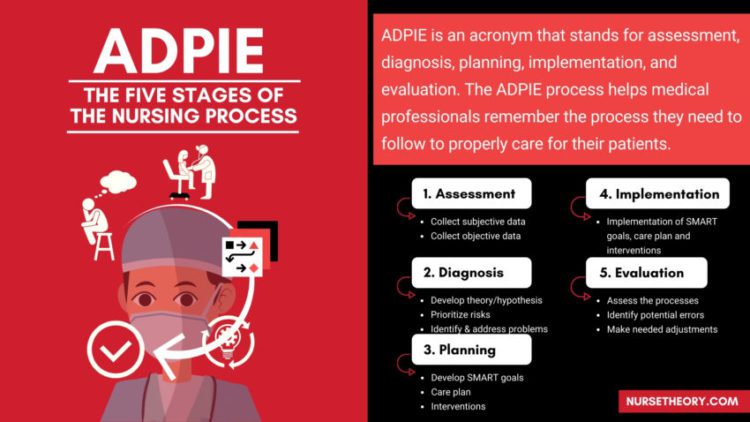
ADPIE is an acronym that represents the five stages of the nursing process:
• Assessment
• Diagnosis
• Planning
• Implementation
• Evaluation
These five steps create a structured framework that nurses use to assess patients, identify potential health concerns, develop care plans, and evaluate outcomes.
The ADPIE nursing process is widely taught in nursing education programs because it helps nurses develop critical thinking, clinical judgment, and organized patient care strategies.
By following a systematic process like ADPIE, healthcare professionals can make better decisions, prioritize patient needs, and monitor whether care plans are effective.
What Is ADPIE in Nursing?
ADPIE is a step-by-step clinical framework used in nursing to guide patient care. Each stage builds on the previous step to ensure nurses collect accurate information, identify problems, plan interventions, and evaluate results.
The five stages of ADPIE help nurses:
• gather relevant patient information
• identify health concerns or risks
• develop care plans and treatment strategies
• implement nursing interventions
• evaluate patient outcomes and adjust care when needed
This structured approach improves communication between healthcare providers and helps ensure patients receive consistent, well-planned care.
ADPIE Overview
| Step | Purpose |
|---|---|
| Assessment | Collect patient data and identify potential problems |
| Diagnosis | Analyze data and identify patient health issues |
| Planning | Create measurable goals and care strategies |
| Implementation | Carry out nursing interventions and care plans |
| Evaluation | Determine whether the care plan achieved the desired outcome |
The Five Stages of the Nursing Process
Each step of the ADPIE nursing process plays a critical role in patient care.
1. Assessment
Assessment is the first step of the nursing process. During this stage, nurses gather detailed information about the patient’s health condition.
This information forms the foundation for all later decisions in the nursing care plan.
Assessment may include:
• interviewing the patient
• reviewing medical history
• observing symptoms and behaviors
• performing physical examinations
• reviewing lab results and vital signs
Nurses collect two types of data during the assessment stage.
Subjective data
Subjective data includes information that cannot be directly measured. It often comes from the patient describing symptoms, feelings, or personal experiences.
Examples include:
• pain levels
• fatigue
• anxiety
• dizziness
Objective data
Objective data is measurable and observable. Nurses can verify it using tools or physical examination.
Examples include:
• blood pressure
• body temperature
• heart rate
• oxygen saturation
• weight
Accurate data collection is critical during this stage because it helps nurses develop a clearer understanding of the patient’s condition.
Once sufficient information is gathered, the next step is diagnosis.
2. Diagnosis
During the diagnosis phase, nurses analyze the information gathered during assessment to identify potential health concerns.
Unlike physicians, registered nurses typically do not diagnose medical diseases. Instead, they identify nursing diagnoses that describe patient responses to health conditions.
Nursing diagnoses help guide care planning and patient management.
Nurses often use standardized terminology developed by NANDA International to communicate nursing diagnoses and patient needs.
Examples of nursing diagnoses include:
- Activity intolerance
- Anxiety
- Constipation
- Decreased cardiac output
- Fluid volume deficit
- Hypothermia
- Sleep deprivation
Once potential problems are identified, nurses prioritize them based on severity and risk to the patient.
Life-threatening conditions are addressed first, followed by less urgent concerns.
For example, many nurses use the ABCs of nursing (airway, breathing, circulation) to prioritize patient care.
After prioritizing concerns, nurses move to the planning phase.
3. Planning
Planning involves creating measurable goals and developing a care plan to address the patient’s needs.
One common framework used in nursing care plans is the SMART goal method.
SMART goals are:
• Specific
• Measurable
• Achievable
• Relevant
• Time-based
For example, a SMART goal might involve reducing a patient’s pain level within a specific time frame or improving mobility following a surgical procedure.
During the planning phase, nurses also develop intervention strategies that help patients reach these goals.
Care plans typically include:
• nursing interventions
• patient education strategies
• monitoring plans
• collaboration with other healthcare professionals
Once a care plan is established, the healthcare team can begin implementing it.
4. Implementation
Implementation is the stage where nurses put the care plan into action.
During this phase, nurses perform interventions designed to improve the patient’s condition and help achieve the goals established during planning.
Nursing interventions may include both direct and indirect care.
Direct patient care may include:
• assisting with mobility
• administering medications
• performing wound care
• helping patients with daily activities
Indirect patient care may include:
• coordinating with healthcare providers
• supervising staff
• documenting patient progress
• advocating for patient needs
Nurses must also continuously monitor the patient’s response to treatment and communicate with the healthcare team to ensure the care plan remains appropriate.
5. Evaluation
Evaluation is the final step of the ADPIE process.
During this stage, nurses determine whether the care plan successfully improved the patient’s condition.
Evaluation involves reviewing patient progress and comparing outcomes to the goals established during the planning stage.
If the care plan is not producing the desired results, nurses may:
• reassess the patient
• adjust interventions
• modify goals
• develop new strategies
Because patient conditions can change, evaluation is often an ongoing process that occurs throughout treatment.
Regular evaluation helps ensure the patient continues moving toward recovery or improved health.
Why the ADPIE Nursing Process Is Important
The ADPIE framework helps nurses approach patient care using a logical and organized system.
Benefits of the ADPIE process include:
• improved critical thinking
• more structured clinical decision-making
• better communication between healthcare providers
• improved patient outcomes
• more consistent documentation and care planning
The nursing process also helps reduce errors by encouraging healthcare professionals to regularly reassess patient conditions and adjust care plans when necessary.
ADPIE Recap
The ADPIE nursing process consists of five stages:
1. Assessment – collecting patient data
2. Diagnosis – identifying patient problems
3. Planning – establishing care goals and interventions
4. Implementation – carrying out the care plan
5. Evaluation – determining whether the care plan worked
Each stage builds upon the previous step, creating a structured method for managing patient care.
This systematic approach allows nurses to observe, analyze, plan, implement, and reassess patient treatment in an organized way.
Without structured processes like ADPIE, it would be far more difficult for healthcare professionals to manage complex patient care scenarios.